
The booster came back perfect. The upper stage dropped a $400M satellite in the wrong orbit. It’s complicated.
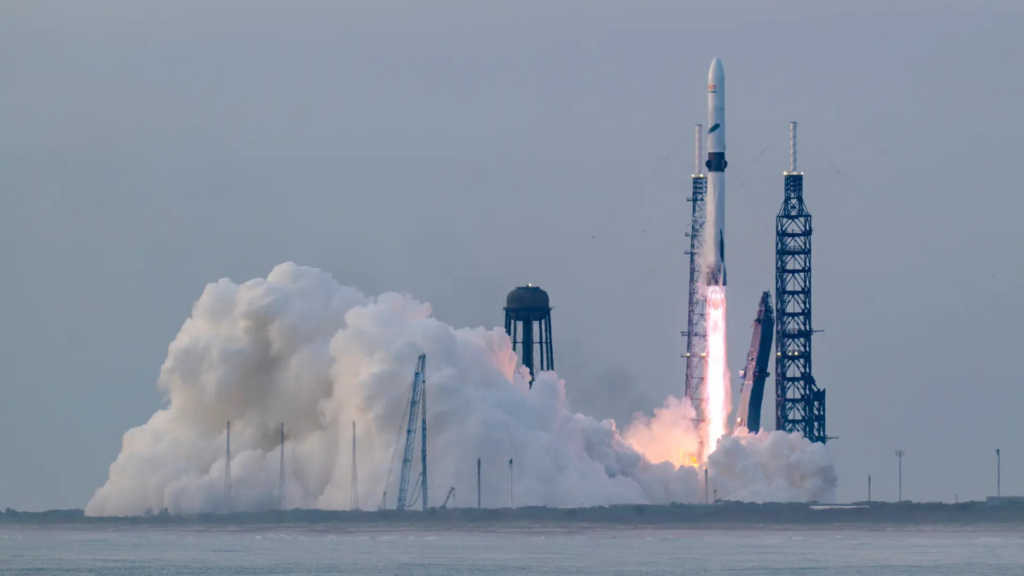
On the morning of April 19, 2026, Blue Origin did something it had never done before: it flew the same New Glenn rocket booster twice. The first stage — technically labeled GS-1 and nicknamed “Never Tell Me the Odds” — lifted off from Cape Canaveral Space Force Station in Florida, separated cleanly from the upper stage, then came back down and landed on a drone ship in the Atlantic Ocean about six minutes later. The Blue Origin team watching on camera erupted. Jeff Bezos shared the landing footage on X. Even Elon Musk, whose SpaceX is Blue Origin’s most direct competitor, offered congratulations.
Then, roughly two hours later, things got complicated.
Blue Origin announced that the payload — AST SpaceMobile’s BlueBird 7 communications satellite — had ended up in an orbit that was “lower than planned.” Not just a little off. Low enough that the satellite’s own propulsion system couldn’t compensate. AST confirmed Sunday afternoon that BlueBird 7 would have to be de-orbited, meaning it will eventually burn up in Earth’s atmosphere. The satellite cost somewhere in the hundreds of millions of dollars, though AST said insurance would cover the loss.
So: a successful first reuse of the booster, and the rocket’s first real mission failure. Both in the same launch window. Make of that what you will.
What Actually Happened on April 19
Liftoff came at 7:25 a.m. EDT — about 40 minutes late due to an unspecified hold in the countdown. When the count finally hit zero, New Glenn’s seven ME-4 methane engines lit and pushed the rocket off the pad on roughly 3.8 million pounds of thrust. The first stage burned for about 3 minutes and 9 seconds, then separated cleanly. Six minutes after liftoff, it touched down on Blue Origin’s drone ship Jacklyn in the Atlantic. Clean recovery.
The upper stage took over from there and carried BlueBird 7 toward its intended low Earth orbit. According to the pre-launch timeline, a second engine burn was supposed to happen about an hour after liftoff to circularize the orbit. It either didn’t fire correctly or didn’t fire at all. Blue Origin CEO Dave Limp later said one of the upper stage engines “didn’t produce sufficient thrust to reach our target orbit.” The satellite separated anyway and powered on successfully — but it was sitting in a highly elliptical, far-too-low orbit it couldn’t escape on its own.
“We have confirmed payload separation. AST SpaceMobile has confirmed the satellite has powered on. The payload was placed into an off-nominal orbit. We are currently assessing and will update when we have more detailed information.” — Blue Origin, via X (April 19, 2026)
BlueBird 7 was no small satellite. It carried a phased array antenna spanning roughly 2,400 square feet — the largest civilian antenna of its type to reach low Earth orbit — and was designed to provide space-based 4G/5G broadband directly to standard cell phones anywhere in the world, through partnerships with AT&T, Verizon, and other carriers. Building one takes time. Losing one matters.
New Glenn’s Track Record So Far
January 16, 2025 — NG-1: First Flight New Glenn’s debut, more than a decade in the making. Carried Blue Ring Pathfinder hardware to orbit. The booster attempted to land but was lost at sea. The mission itself reached orbit successfully.
November 13, 2025 — NG-2: Second Flight — First Booster Landing Carried two NASA ESCAPADE spacecraft toward Mars. The booster successfully landed on the drone ship Jacklyn — making Blue Origin only the second company, after SpaceX, to land an orbital rocket booster vertically.
April 19, 2026 — NG-3: First Booster Reuse — But Upper Stage Fails. The same NG-2 booster flies again and lands again successfully. But an upper-stage engine underperforms, placing AST SpaceMobile’s BlueBird 7 satellite in an orbit too low to sustain. The FAA classified the event as a mishap and grounded New Glenn pending investigation.
New Glenn vs. Falcon 9: Where Things Stand
Blue Origin’s long-term ambition is to compete directly with SpaceX for commercial, national security, and NASA missions. Here’s how the two rockets compare on their reuse records:
| Metric | New Glenn (Blue Origin) | Falcon 9 (SpaceX) |
|---|---|---|
| First flight | January 2025 | June 2010 |
| Total launches (as of Apr 2026) | 3 | 300+ |
| First booster landing | November 2025 (2nd flight) | December 2015 (20th flight) |
| First booster reuse | April 2026 (3rd flight) ✓ | March 2017 |
| Designed reuse capacity | Up to 25 flights per booster | 20+ flights per booster |
| Booster landing success rate | ~67% (1 of 3 recovered, then reused) | ~95%+ |
| First payload loss | Flight 3 (BlueBird 7) | Flight 19 (2015 ISS cargo) |
| Propellant | Liquid oxygen + methane | Liquid oxygen + RP-1 (kerosene) |
| Height | 321 feet | 229 feet |
Sources: Wikipedia/New Glenn, Spaceflight Now, SpaceX
Why Reusability Is the Whole Game
It’s worth stepping back to explain why Blue Origin was chasing this milestone so hard. Reusability is not just a technical talking point — it’s the difference between a profitable launch business and one that bleeds money on every flight.
SpaceX figured this out first with Falcon 9. Each booster costs roughly $60 million or more to build. When you can fly that same booster 10, 15, or 20 times, the math changes completely. SpaceX used that economic advantage to steadily undercut competitors on price while still turning a profit, and it now holds an overwhelming share of the global commercial launch market. Blue Origin — which spent the better part of a decade developing New Glenn — is trying to replicate that playbook.
AST SpaceMobile had planned to reuse the New Glenn booster every 30 days as part of their launch cadence agreement. That kind of turnaround — comparable to what SpaceX achieves with mature Falcon 9 boosters — would only be possible if reuse is reliable and predictable. Sunday’s booster success is an encouraging sign that Blue Origin can get there. The upper stage failure is a reminder they’re not all the way there yet.
“To support our launch cadence during 2026, we expect the New Glenn booster to be reused every 30 days.” — Abel Avellan, CEO of AST SpaceMobile, March 2026 earnings call
2025 Global Orbital Launch Share (Approximate)
SpaceX (Falcon 9 / Falcon Heavy)~65%
Other (Ariane, ISRO, Rocket Lab, etc.)~30%
Blue Origin (New Glenn)~5%
Approximate estimates based on 2025 launch manifests. Blue Origin’s share is expected to grow as launch cadence increases.
What This Means for AST SpaceMobile
AST SpaceMobile is building a satellite-based broadband network designed to let standard smartphones connect directly to space — no special hardware, no satellite phone. The company has partnerships with AT&T, Verizon, and several international carriers, and it’s in a tight race with SpaceX’s own Starlink direct-to-device offering, which launched under a T-Mobile partnership in 2022.
BlueBird 7 was supposed to be the second of AST’s next-generation Block 2 satellites in orbit. These are not small birds: each one features a 2,400-square-foot antenna, roughly the size of a large suburban home’s footprint. BlueBird 6 launched successfully on an Indian LVM3 rocket in December 2025. BlueBird 7 was next in line.
AST said it still expects to have roughly 45 satellites in orbit by the end of 2026 and is targeting a launch every one to two months across its different providers. The satellite’s cost should be covered by insurance. Still, losing a Block 2 satellite sets back the network buildout, and direct-to-device is a market where moving fast matters. SpaceX isn’t standing still.
| Satellite | Antenna Size | Launch Vehicle | Launch Date | Outcome |
|---|---|---|---|---|
| BlueBirds 1–5 (Block 1) | 693 sq ft each | Falcon 9 | Various | Operational |
| BlueBird 6 (Block 2) | 2,400 sq ft | Indian LVM3 | Dec 2025 | Operational |
| BlueBird 7 (Block 2) | 2,400 sq ft | New Glenn NG-3 | Apr 19, 2026 | De-orbiting (wrong orbit) |
| BlueBirds 8–60 (Block 2) | 2,400 sq ft each | Falcon 9 / LVM3 / New Glenn | 2026–2027 | Planned |
AST SpaceMobile constellation status as of April 2026. Source: AST SpaceMobile, CBS News
What Went Wrong — and What Comes Next
Blue Origin CEO Dave Limp pointed to the upper stage’s second burn as the likely culprit. That burn — meant to circularize the orbit about an hour after liftoff — apparently didn’t generate enough thrust. Whether that was a hardware failure, a software issue, or something else entirely won’t be known until the investigation concludes.
The Federal Aviation Administration has classified the event as a mishap and grounded New Glenn until Blue Origin determines what went wrong and puts corrective actions in place. The FAA will oversee the Blue Origin-led investigation at every step and approve the final report before any return to flight.
The grounding has real consequences. Blue Origin had been eyeing an uncrewed test launch of its Blue moon lunar lander later this year — a critical demonstration for NASA’s Artemis program. Amazon’s LEO satellite network also needs New Glenn missions to get off the ground. Both programs now sit in a holding pattern while the upper stage investigation runs its course.
What Blue Origin Is Building Toward
Despite the mishap, Blue Origin’s broader ambitions haven’t changed. The company holds a NASA contract worth up to $3.4 billion to develop the Blue Origin lander for the Artemis program, a National Security Space Launch Phase 3 contract worth an estimated $2.4 billion over seven flights, and plans to use New Glenn to help build Amazon’s Project Kuiper satellite internet constellation.
The company also announced in April 2026 that it’s working with the U.S. Space Force to develop polar orbit capabilities at Vandenberg Space Force Base in California. And in November 2025, Blue Origin revealed a new variant called New Glenn 9×4 — a super heavy-lift version designed to deliver more than 70,000 kilograms to low Earth orbit.
None of that changes what has to happen next: the FAA investigation has to conclude, corrective actions have to be approved, and New Glenn has to fly again without incident. The company’s credibility as a reliable launch provider depends on it.
The Bottom Line
Blue Origin achieved something real on April 19: successfully reflying a heavy-lift orbital booster is not a given, and the New Glenn booster performed exactly as intended. That matters for the company’s long-term economics and its standing against SpaceX.
But the upper stage failure is a problem that can’t be minimized. Delivering a satellite to the wrong orbit during just the third-ever New Glenn launch — and only the second commercial payload flight — raises genuine questions about the rocket’s readiness for high-stakes work, particularly the NASA lunar missions on the calendar.
There’s a useful comparison here: SpaceX had its own payload loss on Falcon 9’s 19th mission in 2015, and again in 2016. The company fixed the problems and went on to dominate the industry. That history suggests early failures aren’t fatal. But fixing upper stage reliability quietly, quickly, and completely is now the only thing that matters for New Glenn’s near-term future.
Key Takeaways
| Event | Result |
|---|---|
| New Glenn NG-3 liftoff from Cape Canaveral | Successful |
| First stage (GS-1) booster reuse | Successful — 1st ever for New Glenn |
| Booster recovery on drone ship Jacklyn | Successful (2nd recovery overall) |
| Upper stage second burn | Insufficient thrust — root cause under investigation |
| BlueBird 7 orbit insertion | Off-nominal — satellite to be de-orbited |
| FAA classification | Mishap — New Glenn grounded pending investigation |
Further Reading: TechCrunch — Blue Origin reuse report · Spaceflight Now — Full launch report · Wikipedia — New Glenn overview · GeekWire — Mission analysis · Space.com — Launch video & recap
