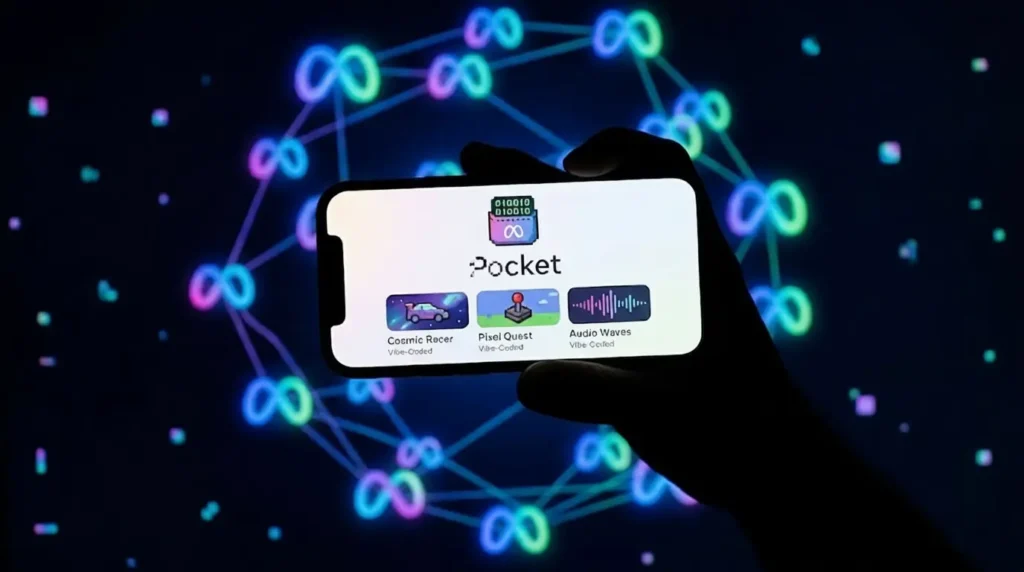
Meta has quietly released Pocket, a new app that lets users generate small, interactive games by typing a description of what they want. Meta didn’t put out a press release. There was no keynote, no “introducing” post from Mark Zuckerberg. The app just appeared in app store listings, and it took a reverse engineer scrolling through Google Play screenshots to notice it was there at all.
That’s Pocket: a new Meta app that lets you type a sentence and get a small, playable game out the other end. Meta calls these creations “gizmos.” Type something like “a puzzle where a paper airplane dodges thunderstorms,” and Pocket tries to build it on the spot, with no coding involved.
The app first appeared on the App Store and Google Play on June 29, 2026, according to app intelligence firm Appfigures. It went largely unnoticed until July 2, when reverse engineer Alessandro Paluzzi spotted the Google Play listing and shared screenshots on X. Meta has not issued an official announcement and did not respond to requests for comment from multiple outlets.
Here’s what’s actually known so far, and what’s still unclear.
What is Meta’s New App Pocket
Pocket combines two things Meta has been chasing for a while: AI content generation and social discovery feeds. You open the app, describe an interactive experience in plain language, and the AI assembles a small playable “gizmo” with visuals, sound, and basic game logic attached. From there, you can post it to a scrollable feed where other users browse, play, and remix what people have made.
Based on the app’s Play Store listing, gizmos can respond to touch and phone tilt, play sound effects and music, and in some cases pull in your camera or photo library. That’s a step beyond the static AI images and short videos Meta has already been generating through its Meta AI app and its video tool, Vibes. Pocket is Meta’s first real attempt at AI-generated content you interact with, rather than just look at.
Quick facts:
- Developer: Meta Platforms
- First listed: June 29, 2026
- Publicly spotted: July 2, 2026
- Core feature: Prompt-to-game “gizmos”
Where “vibe coding” fits in
If you’ve spent any time on developer social media over the past year, you’ve probably run into the term “vibe coding” — describing what you want in plain English and letting an AI model write and run the underlying code, without you touching an editor yourself. Pocket points that idea specifically at games. You’re not writing Python or C#. You describe an outcome, and a model handles the implementation underneath.
The idea isn’t originally Meta’s. Pocket is built on technology from a startup called Gizmo, legally known as Atma Sciences Inc., which Meta acquired earlier this year along with a non-exclusive license to the underlying tech. Gizmo’s own app reportedly remains available on app stores, and side-by-side screenshots show a strong family resemblance: the same basic prompt-to-interactive-content idea, the same style of discovery feed.
Pocket vs. Roblox vs. building a game the old-fashioned way
People keep comparing Pocket to Roblox, since both mix creation tools with a social feed. I think the more useful comparison also includes traditional game engines, since that’s the barrier Pocket is claiming to remove. Here’s how the three stack up on paper:
| Factor | Roblox | Unity / Unreal | |
|---|---|---|---|
| Skill needed | None — just a text prompt | Lua scripting, design tools | Programming, engine knowledge |
| Time to a playable build | Seconds to minutes | Hours to days for a rough prototype | Days to weeks, minimum |
| Creative control | Low — the model fills in most details | High — you build every system yourself | Highest — full control, full workload |
| Distribution | Built-in feed inside the app | Built-in platform with its own economy | You handle it (Steam, app stores, etc.) |
| Creator payouts | Not disclosed as of this writing | Robux-based creator program | Up to the developer |
Why the market paid attention
Meta hasn’t confirmed most of this officially, but the news traveled fast enough to move stock prices. Shares of both Roblox and Unity Software dipped after reports of Pocket’s launch started circulating. That reaction says something on its own: a company with a combined user base in the billions deciding to compete, even quietly, in the “make a game and share it” space isn’t a small thing, regardless of how rough the actual gizmos turn out to be on day one.
It also fits a pattern I’ve watched Meta repeat a few times now: spin up a narrow, standalone app, let it exist without much promotion, see what sticks, then either fold the useful parts into a bigger product or let the app quietly fade. That’s more or less what’s happened with several of its past AI experiments. Pocket looks like the gaming-flavored version of the same playbook.
What I’m not sold on yet
Getting a model to generate something short and fun once is one problem. Getting it to generate something people want to open again tomorrow is a much harder one. Text-to-game generation has to juggle mechanics, difficulty, visual coherence, and some kind of loop worth repeating — a different order of difficulty than generating a still image or a ten-second clip.
I also haven’t found anything from Meta yet about whether creators get paid, or how the company plans to moderate a feed of AI-generated interactive content once it has real numbers behind it — worth flagging given that gizmos reportedly can tap into a user’s camera and photo library. None of this rules Pocket out. It’s just early, and Meta hasn’t said much publicly.
Where things stand right now
As of this week, Pocket is live but not promoted — downloadable, but not pushed through Meta’s usual marketing channels. Appfigures, the app-intelligence firm that first flagged the listing dates, said it couldn’t yet tell whether the app had picked up any meaningful downloads. That’s consistent with a company testing the water rather than making a big bet.
Two things I’ll be watching over the next few months: whether Meta ever says anything official about Pocket, and whether the gizmos people generate are good enough to open twice, rather than something you try once out of curiosity and forget. If it’s the second one, Pocket probably ends up as a footnote. If it’s not, don’t be surprised if pieces of this show up inside Instagram or Facebook eventually.
Further reading:
- TechCrunch: Meta quietly launches vibe-coded gaming app Pocket — https://techcrunch.com/2026/07/02/meta-quietly-launches-vibe-coded-gaming-app-pocket/
- Digital Trends: Meta just launched a vibe-coding app for games — https://www.digitaltrends.com/phones/meta-just-launched-a-vibe-coding-app-for-games-and-its-called-pocket/
- Investing.com: Meta launches Pocket app for AI-generated interactive content — https://www.investing.com/news/stock-market-news/meta-launches-pocket-app-for-aigenerated-interactive-content-93CH-4773642
This article reflects publicly available information as of July 3, 2026. Meta has not issued an official statement about Pocket, and details may change as the company comments further.