
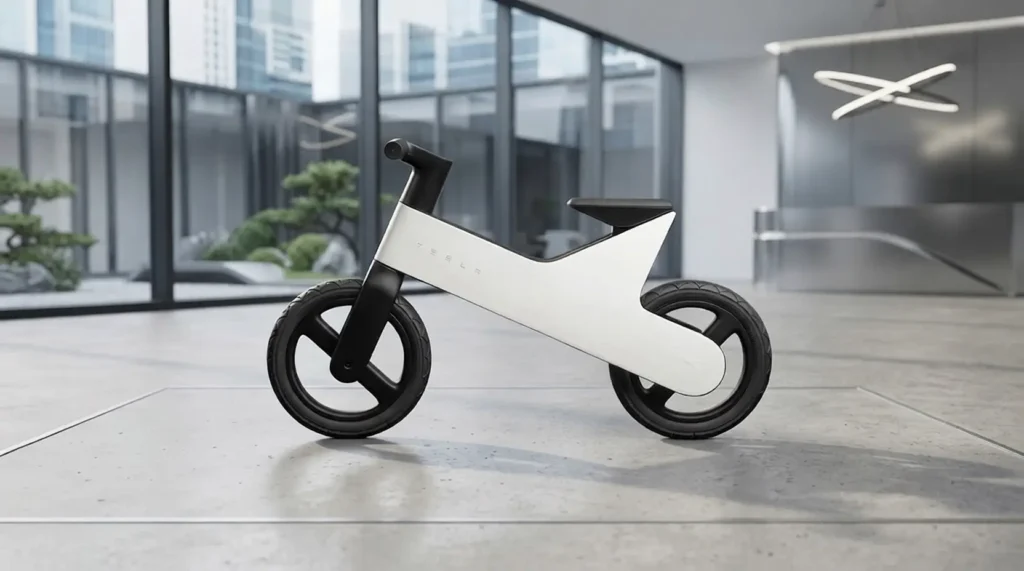
I’ve been covering Tesla’s product launches for a while now, and this one made me do a double-take. Not because it’s impressive — it’s a kid’s toy, essentially — but because of how many people saw the headline “Tesla launches a bike” and got their hopes up for something it was never going to be.
So let’s clear that up first: this is not an e-bike. It has no motor, no battery, no pedals, and no chain. It’s a balance bike, the pedal-free two-wheeler that toddlers push along with their feet to learn balance before they ever touch a real bicycle. Tesla calls it the Balance Bike for Kids; it costs $225, and it sold out within hours of going live on the Tesla Shop.
Here’s what it is, how it compares to what’s already out there, and whether the price makes any sense.
The basics of the Tesla Balance Bike
Tesla’s bike is built for children roughly 2 to 5 years old, with a magnesium frame, an adjustable seat with five height positions, and the expected Tesla styling — wordmark on the side, “T” logo up front. It ships with the tools needed for assembly, which Tesla says takes a few minutes.
| Spec | Detail |
|---|---|
| Price | $225 (US) |
| Recommended age | 2–5 years |
| Frame material | Magnesium |
| Minimum leg length | 13.7 in (35 cm) |
| Recommended weight limit | 66.1 lb (30 kg) |
| Maximum weight limit | 77.1 lb (35 kg) |
| Seat height positions | 5 |
| Brakes | None |
| Pedals | None |
| Assembly | Required, tools included |
That’s genuinely all there is to it. No app, no sensors, no software — a rare thing for a Tesla product these days, and honestly kind of refreshing.
Why magnesium matters here
The material is worth a second look, because it’s not just a marketing line. Magnesium is lighter than aluminum and considerably lighter than the steel most budget balance bikes use, while still holding up structurally. On a bike this small, that weight difference is the whole point: the bike isn’t being ridden so much as carried, dragged, and occasionally thrown across a room by a two-year-old who’s had enough. A frame that’s easy to lift makes the entire learning process less frustrating for the kid and less annoying for the parent picking it back up.
How it stacks up against the competition
Tesla didn’t invent a new category here — balance bikes have been a fixture of toddler gear since the mid-2000s, and a few brands already dominate the “premium” end of the market. I pulled current pricing and specs on the closest comparable models to see where Tesla’s bike actually lands.
| Bike | Price | Frame | Weight | Notes |
|---|---|---|---|---|
| Tesla Balance Bike for Kids | $225 | Magnesium | Not disclosed | No brakes, ages 2–5 |
| Woom 1 | $249 | Magnesium/alloy | ~7.9 lb | Optional disc brake, ages 1.5–3.5 |
| Strider 14x Sport | $249 | Steel | 12.5 lb | Converts to pedal bike, ages 3–7 |
| Hornit AIRO | ~$73 | Magnesium | Lightweight | Budget magnesium option |
A few things stand out once you put these side by side. Tesla’s $225 price tag sits right in the same range as Woom and Strider, two brands with over a decade of balance-bike-specific engineering behind them — geometry testing, brake options, warranty programs, the works. Tesla is a first-time entrant charging first-tier prices. That’s not necessarily a problem, but it’s worth knowing going in.
The bigger gap is on brakes. Woom offers an optional disc brake, and Strider’s pedal-mode conversion includes a coaster brake. Tesla’s bike has none, which is standard for a pure balance bike but means you’re not getting more for your money on that front — you’re mostly paying for the badge and the magnesium frame, both of which Hornit offers for a third of the price.
This isn’t Tesla’s first kids’ vehicle
If the balance bike feels like a random detour, it’s not really new territory for Tesla. Back in 2021, the company partnered with Radio Flyer on the Cyberquad for Kids, a battery-powered mini-ATV styled after the Cybertruck. It originally sold for $1,900, hit a top speed of 10 mph, and was later recalled over safety concerns before returning in an updated form. Compared to that, a $225 pedal-free push bike is about as low-risk a product as Tesla could release — no battery, no motor, nothing to recall.
Why fans are a little deflated
For years, surveys have named Tesla as the brand people most want to see build an electric bicycle, and rumors of a “Model B” e-bike have floated around Tesla forums since roughly forever. Elon Musk has both teased and dismissed the idea at different points. So when “Tesla bike” started trending, a lot of adult fans assumed this was finally it.
It wasn’t. And I think that’s the most interesting part of this story, honestly — not the bike itself, but what it says about Tesla’s merchandise strategy. The company has quietly built out a whole line of lifestyle products (apparel, the Cyberquad, now this) that trade on the brand without touching the actual EV business. It’s a low-cost way to keep the Tesla name in front of people, sell out fast on hype, and generate headlines like this one. Mission accomplished, in that sense.
Should you actually buy it?
If you’re a Tesla owner who wants matching branded gear for your kid, sure, it’s a nicely made bike at a fair-if-not-cheap price. If you’re just shopping for a balance bike and don’t care about the logo, I’d look at what you’re actually optimizing for:
- Lowest weight for a very young rider (18 months–3 years): Woom 1 or a similar 12-inch magnesium bike.
- Longest useful life, with a path to pedaling: Strider 14x Sport, since the pedal kit extends its usefulness well past the balance-bike stage.
- Cheapest magnesium frame: Hornit AIRO, at roughly a third of Tesla’s price.
- The badge: Tesla’s bike, assuming it’s back in stock.
As of this week, Tesla lists the bike as out of stock in the US, with orders reportedly shipping again toward the end of August. There’s a notify-me option on the product page if you want one.
A quick safety note
Whatever brand you land on, the U.S. Consumer Product Safety Commission and pediatric groups generally recommend checking three things before buying any balance bike: that the seat height lets your child’s feet reach flat on the ground with knees slightly bent, that the bike weighs comfortably less than half your child’s body weight, and that you use a properly fitted helmet every time — balance bikes can reach real speed on a downhill. The Balance Bike Wikipedia entry has a decent overview of the category’s history if you’re curious where the whole concept came from (it traces back to a wooden two-wheeler built in 1817, which is a fun fact to have on hand at the playground).
FAQ
Does the Tesla Balance Bike have pedals?
No. It’s a pure balance bike — no pedals, no chain, no drivetrain. Kids propel it by pushing off the ground with their feet.
What age is it designed for?
Tesla recommends it for children 2 to 5 years old, with a minimum leg length of 13.7 inches and a maximum rider weight of 77.1 lb.
Is it available right now?
It sold out within hours of launch. Tesla’s shop currently lists it as out of stock, with new orders expected to ship in late August.
Does it have brakes?
No. Like most balance bikes in this category, it relies on the rider dragging their feet to slow down.
Is this the Tesla e-bike people have been asking for?
No. This is a toddler’s push bike, not an electric bicycle. Tesla hasn’t announced an e-bike.